
How to be Love in Action
It’s a well-known fact—there are a lot of baby boomers. This generation is the largest by far, and for decades, the United States braced for impact (rather than planning well) for this outsized segment of the population to age.
As a proud member of the “nowhere generation,” I can recall many conversations about how the size of this generation would impact my retirement and social security. The message was clear: no one is going to take care of you.
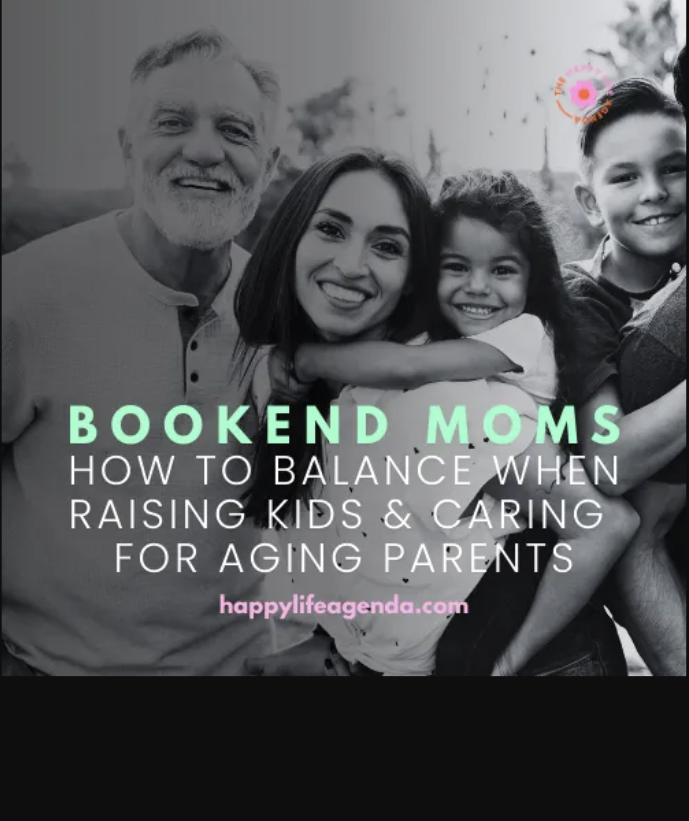
But this conversation isn’t about who is going to care for Generation X and beyond when government programs are dried up. This is about the unpaid caregivers of the U.S.—nearly 60 percent are women—who are caring for children or adults or both. Many still hold down a job and destroy their own well-being to prop everyone else up.
I interviewed Kerry Gannaway, resident Happy Life Agenda expert on over 40 fitness for women, who is caring for an aging parent with an 11-year-old daughter at home while also working full-time
Kerry shares the responsibility with her sister—taking turns and shifts visiting their dad in the nursing home.
My parents live about 40 minutes away from me, and though still mostly self-sufficient, there are times they need help with doctor’s appointments or yardwork. I have a 7-year-old daughter, too. I aim to visit twice per week and (among many other reasons, but this was a factor) changed jobs to be more available to go with my mom to doctor’s appointments as her memory has declined significantly in the past three years. My brothers are local, caring for teenagers at this stage in life, but they stop by as well to help with yardwork or share a meal. We are lucky—my parents can still care for themselves day to day and even spend time with their granddaughter, so my husband and I can go out for a night.
I have friends who are building tiny homes on their property to accommodate aging parents.
My aunt is living with my grandmother and step-grandfather—her kids are grown, but she is now effectively “raising her mother.”
what to do when it's an obligation
In the interview, Kerry very aptly states that not everyone has the loving relationship that I do with my parents. She’s right.
Kerry shares her story about her father, but what she showcases (and I am finding common among a lot of Boomers and Generation X) is that their parents existed in a world where no one talked about their problems. If work was hard, even if you felt scared, anxious, depressed, or miserable, you swallowed it down like a jagged little pill and made life work.
Traumatic for the parent and for the kids, too.
From some of these stories, you can see that the parent (or parents) was trying to protect their children from the ugliness they saw or were enduring, propping up an invisible force field. However, that type of strength can impact your personality and how you show up.
Many of these people who tell these stories describe their parents as rough, rigid, unkind, and not very accepting or loving.
To bring context, one story is of a woman (of “The Greatest Generation”) whose own mother was verbally abusive and cruel. When she married young to escape that cruelty, it is almost as if she ran into the arms of another abusive situation—but she had to protect her children (Boomer Generation). For all she did to give them everything they needed and hide the ugly things happening in the same household, they hate her for it. Even today, as she is wilting with old age, there is no forgiveness—the stories are laid bare in pieces as her memory fragments—she still wants to hide it all, but her walls are crumbling under the weight of health issues and advanced aging.
All this is to say that if you find yourself caring for a parent where love is hard to come by, consider the root cause. Learn the stories. Forgive.
The burden of not forgiving and ruminating weighs on you more than it does them. There is research (1,2) today to support this. From what I have observed, it can destroy your health in different ways. You have a choice: learn from it and leverage it, or let it take you down.
Creating harmony in chaos
It is easy to prefer the neat, straight lines that life seems to flow for kids, where, in many cases, your parents are bearing the brunt of finances, broken systems, and a failing economy. Adulthood can be a rude awakening, and nothing prepared anyone for caring for your parents and your kids simultaneously. Nothing, to be honest, even really prepares you for parenthood. Let’s be real, it takes more experience and skill to be given an entry-level job than to have a baby or get a driver’s license (we can talk about that more later). That means you have to be the expert of your own world. Seek solutions rather than complaining about circumstances.
- Time management. I never thought I was bad at time management until I was getting “hit” from all sides. I was an executive, I had a young child, and suddenly, my parents needed more help. I took a course on time management. Even when you think you know it all, you don’t. There was some overlap in techniques, but there was a lot of valuable wisdom, too
- Meditate. Kerry talks about finding 5 minutes for yourself. Whether it is journaling or quiet meditation—going to a center and listening in stillness can make everything“figureoutable.”
- Prioritize yourself. You don’t have to be superwoman. Ask for help, build in time for yourself. If you don’t take care of you, when your loved one passes on, what will you do? They lived their life—make them comfortable and cared for, but don’t aim for an Oscar-winning performance.
- Combat loneliness. Many people feel very isolated and alone when caring for elderly parents. It doesn’t exactly open up your social circle like becoming a parent. Intentionally seek out groups and others who are going through a similar situation. It helps to know someone else shares the struggle.
REFERENCES
- Ingersoll-Dayton B, Torges C, Krause N. Unforgiveness, rumination, and depressive symptoms among older adults. Aging MentHealth. 2010 May;14(4):439-49. doi: 10.1080/13607860903483136. PMID: 20455120; PMCID: PMC2868276.
- Kim JJ, Payne ES, Tracy EL. Indirect Effects of Forgiveness on Psychological Health Through Anger and Hope: A ParallelMediation Analysis. J Relig Health. 2022 Oct;61(5):3729-3746. doi: 10.1007/s10943-022-01518-4. Epub 2022 Feb 21. PMID:35190955; PMCID: PMC10120569.